 listicle
7 Steps to Enroll in Medicare Part A and B
Table of Contents
- Step 1: Confirm Your Eligibility for Medicare Part A and Part B
- Step 2: Understand Your Medicare Initial Enrollment Period
- Step 3: Gather Required Documents and Information
- Step 4: How to Sign Up for Medicare Online
- Step 5: Complete the Medicare Part B Enrollment Form CMS-40B
- Step 6: Know Your Options During a Medicare Special Enrollment Period
- Step 7: Confirm Your Enrollment and Receive Your Medicare Card
- Common Mistakes to Avoid When Enrolling
- Frequently Asked Questions
Last Updated: October 7, 2026
Step 1: Confirm Your Eligibility for Medicare Part A and Part B
You're eligible for Medicare at 65, regardless of employment status. If you receive Social Security benefits, you're automatically enrolled in Part A, but to enroll in Medicare Part A and B together, Part B requires a separate decision, where many people make costly mistakes.
To confirm eligibility, check three things: age (65+), citizenship (U.S. citizen or permanent resident for at least five years), and work history. You need 40 quarters (roughly 10 years) to get premium-free Part A. Without 40 quarters, you can still enroll in Part B, but Part A costs a monthly premium.
Your work history matters more than you might think. If you worked under a different name, in multiple states, or took time out of the workforce, your Social Security record might not reflect your actual eligibility.
Many assume they're automatically enrolled in both parts. Part A is automatic if you receive Social Security, but Part B is not, you must actively enroll during your Initial Enrollment Period, or face lifelong late-enrollment penalties.
Step 2: Understand Your Medicare Initial Enrollment Period
Your Initial Enrollment Period is a seven-month window that centers on your 65th birthday. It starts three months before the month you turn 65 and ends three months after.
Timing matters because your coverage start date depends on when you apply.
This period is your one chance to avoid the Part B late-enrollment penalty: a permanent 10% premium increase for each year you delay after your Initial Enrollment Period ends. Delay three years and you pay 30% more for life, even if you switch plans later.
Miss your Initial Enrollment Period and you must wait for the General Enrollment Period (January 1-March 31 each year), with coverage not starting until July 1, and you'll still owe the late-enrollment penalty.
According to Medicare's official enrollment guidance, understanding your enrollment period is the foundation of avoiding costly mistakes. At Your Medicare Advantage Guy, we help seniors navigate these deadlines.
Step 3: Gather Required Documents and Information
Before you apply, collect your Social Security number, proof of citizenship (passport, birth certificate, or naturalization papers), and current health insurance information. If you're still working, gather your employer's health insurance details, you may need to prove creditable coverage.
Have your work history ready, including U.S. employment dates. If you worked for multiple employers or took breaks, write those dates down, it helps Social Security verify your 40 quarters quickly.
If you're applying for Part B while still covered by an employer plan, bring documentation of that coverage, a benefits letter, insurance card, or summary of benefits.
You'll also need your mailing address, phone number, and email address for the card application. Medicare mails your card, so make sure the address is current and receives mail reliably during your enrollment window.
If you're married or have dependents affected by your Medicare choices, bring their information too, your spouse's age and coverage status can influence your decisions about Original Medicare versus Medicare Advantage.
Step 4: How to Sign Up for Medicare Online
The fastest way to enroll in Medicare Part A and Part B is through Medicare's official online application. Go to Medicare.gov, find the "Sign Up for Medicare" section, and select "Apply Online Now." You'll create an account or log in with your existing Medicare.gov username.
The online application walks you through eligibility, asks about your work history, and lets you apply for Part A and Part B together or separately. Most people finish in 10-15 minutes, and the system confirms eligibility in real time.
After you submit, Social Security reviews your application within two weeks. You'll get a confirmation letter, then your Medicare card.
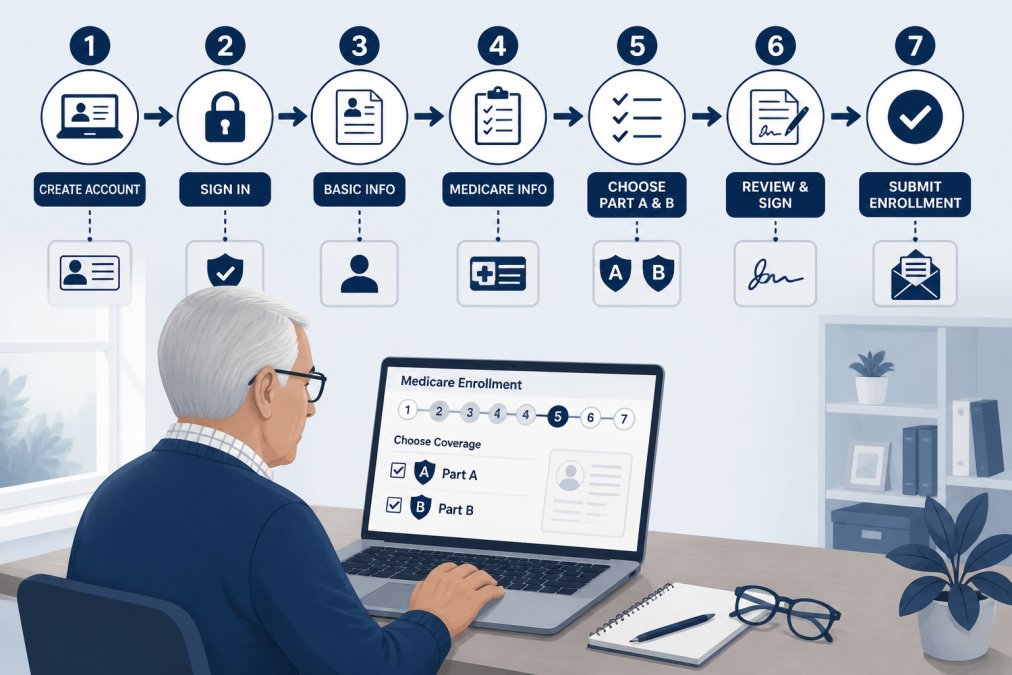
Keep your confirmation number to check your application status or call Social Security with questions. Write it down or screenshot it before closing the browser.
If you can't apply online, call Social Security at 1-800-772-1213 (Monday-Friday, 7 a.m. to 7 p.m. local time) for help over the phone, or visit your local office in person. Most people prefer online because it's faster and confirms immediately.
Step 5: Complete the Medicare Part B Enrollment Form CMS-40B
If you're not automatically enrolled in Part B, because you're still working and covered by an employer plan, for example, you'll need to complete Form CMS-40B when you're ready to enroll. This form tells Medicare you want Part B coverage.
The CMS-40B is simple: provide your personal information, Social Security number, and the effective date you want Part B to start. If you lost employer coverage, include the end date, it helps Social Security determine if you qualify for a Special Enrollment Period, which protects you from late-enrollment penalties.
Submit the CMS-40B online through Medicare.gov, by mail, or in person at your local Social Security office. Online is fastest with immediate confirmation; by mail, allow two to three weeks; in person, you get confirmation on the spot.
If you're applying for Part B after your Initial Enrollment Period because you had employer coverage, include proof, a benefits letter, insurance card, or employer certification. Without it, Social Security can't verify your Special Enrollment Period eligibility, and you'll face late-enrollment penalties.
Step 6: Know Your Options During a Medicare Special Enrollment Period
A Special Enrollment Period gives you extra time to enroll in Medicare Part B without penalties if certain life events happen. Losing employer coverage is the most common reason for a Special Enrollment Period.
Other qualifying events include losing COBRA coverage, losing Medicaid, moving out of your plan's service area, or your employer plan dropping your coverage. The window is typically 60 days from the date coverage ends.
The key to using a Special Enrollment Period is documentation. You need proof that you had creditable coverage, a benefits letter from your employer, an insurance card, or a COBRA notice. Without documentation, Social Security can't verify you qualify for the Special Enrollment Period, and you'll be subject to late-enrollment penalties.
Many people don't realize they have a Special Enrollment Period and give up, assuming they missed their deadline. But if you lost employer coverage, you have a second chance: apply within 60 days, provide proof, and you're protected.
At Your Medicare Advantage Guy, we help seniors understand whether they qualify for a Special Enrollment Period and apply correctly.
Step 7: Confirm Your Enrollment and Receive Your Medicare Card
After Social Security processes your application, you'll get a confirmation letter showing your enrollment status, coverage start date, and Medicare claim number. Keep it safe, you'll need the claim number to set up online accounts, request medical records, or appeal claim denials.
Your Medicare card arrives separately, usually within two to four weeks of approval. It shows your claim number, name, and enrolled parts (Part A, Part B, or both), and you'll use it at every doctor or hospital visit.
Before coverage starts, review your confirmation letter carefully. Check your name, Social Security number, and coverage dates; if anything is wrong, call Social Security at 1-800-772-1213 to correct it.
Once you have your Medicare card, you're ready to use your benefits. Schedule a preventive health visit with your primary care doctor.
If you enrolled in Original Medicare (Part A and Part B), you can now compare Medicare Advantage plans during the Open Enrollment Period (October 15 through December 31 each year). Many seniors switch to Medicare Advantage to lower their out-of-pocket costs and simplify their coverage.
Common Mistakes to Avoid When Enrolling
The biggest mistake seniors make is delaying Part B enrollment thinking they'll apply later. Later becomes too late, and they're stuck with a permanent penalty. If you're eligible, enroll during your Initial Enrollment Period.
Another common error is not understanding the difference between automatic Part A enrollment and Part B enrollment. Just because you're automatically enrolled in Part A doesn't mean you're enrolled in Part B.
Failing to report life changes is another trap. If you lose employer coverage, move, or retire, tell Social Security immediately.
Some seniors enroll in Part B but don't understand their coverage. They think Medicare covers everything, then get surprised by deductibles, coinsurance, and out-of-pocket costs.
Finally, many people don't compare their options. They assume Original Medicare is their only choice or that all Medicare Advantage plans are the same. They're not.
| Mistake | Impact | How to Avoid |
|---|---|---|
| Missing Initial Enrollment Period | Permanent late-enrollment penalty on Part B | Apply during your seven-month window centered on your 65th birthday |
| Not understanding automatic Part A enrollment | Thinking you're enrolled in Part B when you're not | Actively choose Part B during your Initial Enrollment Period |
| Failing to report life changes | Losing Special Enrollment Period protection | Tell Social Security within 60 days of losing employer coverage |
| Not comparing coverage options | Paying more than necessary for your coverage | Compare Original Medicare, Medicare Advantage, and supplemental plans during Open Enrollment |
| Ignoring coverage details | Unexpected out-of-pocket costs | Review your plan's deductibles, coinsurance, and network before your coverage starts |
Enrolling in Medicare Part A and Part B is straightforward when you understand the deadlines and your options. Start by confirming your eligibility, gather your documents, and apply during your Initial Enrollment Period.
Frequently Asked Questions
Can I apply for Medicare online?
Yes. You can enroll in Medicare Part A and Part B online through Medicare.gov or by calling Social Security at 1-800-772-1213. Online enrollment is often the fastest option. If you already have Part A, you can apply for Part B online. You'll need your Social Security number, employment information, and current health insurance details. Contact Social Security directly for the most current application methods and to confirm your eligibility status before starting.
What is the Medicare Initial Enrollment Period and why does it matter?
Your Medicare Initial Enrollment Period is the seven-month window centered on your 65th birthday: three months before, the month of, and three months after. Enrolling during this period helps you avoid late-enrollment penalties on Part B premiums. If you miss this window, you may face higher costs. Some people qualify for a Medicare Special Enrollment Period if they have employer coverage or other qualifying events. Check your specific situation with Social Security to confirm your enrollment deadline.
What documents do I need to enroll in Medicare Part A and Part B?
Gather your Social Security number, proof of citizenship or lawful permanent resident status, and information about any current health insurance (employer coverage, COBRA, or retiree plans). If you're applying for Part B while already on Part A, have your Medicare card handy. If your employer is providing information about your coverage, collect that documentation too. Contact Social Security or visit Medicare.gov to confirm the exact documents required for your situation before you apply.
What happens if I delay enrolling in Medicare Part B?
Delaying Part B enrollment beyond your Initial Enrollment Period may result in a late-enrollment penalty, which increases your monthly premium permanently. The penalty is 10% of the Part B premium for each full year you could have enrolled but did not. Some exceptions exist if you have creditable coverage through an employer or retiree plan. Review your coverage situation carefully and contact Social Security or an independent Medicare advisor to understand whether you qualify for an exception before delaying enrollment.