 comparison
How to Switch From Original Medicare to Medicare Advantage
Quick Summary
Switching to Medicare Advantage bundles hospital, medical and often prescription drug coverage into one plan, and many plans add dental, vision, hearing and fitness benefits that Original Medicare does not cover. Medicare Advantage plans also set an annual out-of-pocket maximum, which Original Medicare lacks. Check each plan's network, formulary and costs before you enroll.
- Medicare Advantage plans typically combine hospital, medical and often Part D drug coverage in one plan.
- Original Medicare has no annual cap on what you pay for covered services.
- Confirm your doctors are in the plan's network before you switch.
- Verify that your prescriptions are on the plan's formulary.
- Enroll during the correct enrollment window and keep your confirmation.
Table of Contents
- Benefits of Switching to Medicare Advantage: What You Gain
- Pros and Cons of Medicare Advantage Plans vs. Original Medicare
- Can You Switch From Medicare Advantage Back to Original Medicare?
- How to Switch Medicare Plans Step by Step
- Special Considerations: Chronic Conditions, Special Needs Plans and Geographic Moves
- Booking Your Free Plan Comparison With Your Medicare Advantage Guy
- Frequently Asked Questions
Benefits of Switching to Medicare Advantage: What You Gain
Last Updated: November 4, 2026
Switching to Medicare Advantage from Original Medicare is one of the most common decisions people face once they become eligible. Your Medicare Advantage Guy provides independent guidance to help Buffalo-area and Western New York residents compare these options before they commit. Medicare Advantage plans, also called Part C, are offered by private insurers approved by Medicare, and they bundle hospital, medical and often prescription drug coverage into one plan (Compare types of Medicare Advantage Plans).
Many people are drawn to these plans because they can offer benefits that Original Medicare does not cover on its own. The right choice depends on your health, your doctors and your budget. This guide walks through what you gain, what you give up, and how to make the switch step by step.
Lower Premiums and Built-In Prescription Drug Coverage
Premiums vary widely by plan and by county, so check the exact figure for your area on Medicare.gov before you decide.
Most Medicare Advantage plans include prescription drug coverage (Part D) in the same plan, which means one card, one premium and one set of rules. Coverage for your specific medications depends on each plan's formulary, so confirm that your prescriptions are covered before you enroll.
Out-of-Pocket Maximums and Cost Protection
Original Medicare has no annual cap on what you pay for covered services. Medicare Advantage plans set an annual out-of-pocket maximum, which limits how much you pay for covered care in a year. Check the figure for each plan on Medicare.gov before you enroll.
Pay close attention to this number when comparing plans. A plan with a low premium but a high out-of-pocket maximum can cost more in a serious health year than a plan with a higher premium and a lower cap. Medicare.gov lets you compare these figures side by side.
The article's key cost and coverage points for Medicare Advantage are summarised below.
| Feature | Medicare Advantage | Original Medicare |
|---|---|---|
| Bundled coverage | Hospital, medical and often Part D in one plan | Hospital and medical coverage only |
| Annual out-of-pocket cap | Set by each plan | No annual cap |
| Premiums | Vary by plan and county | Check Medicare.gov for your area |
| Extra benefits | Often dental, vision, hearing, fitness | Not included |
| Verify before enrolling | Prescriptions on formulary, doctors in network | Not applicable |
Pros and Cons of Medicare Advantage Plans vs. Original Medicare
Medicare Advantage is not automatically better than Original Medicare. To weigh the trade-offs side by side, use a structured method for comparing Medicare Advantage plans. The two systems work differently, and each suits different people.
Many plans also include extras such as dental, vision, hearing and fitness benefits. These supplemental benefits are not part of Original Medicare, so they can add real value if you need them. They are also tied to the specific plan, and they can change from year to year.
Network Restrictions: HMO vs. PPO Trade-Offs
Medicare Advantage plans commonly come in several network styles, such as HMO and PPO. Plan rules on in-network care, referrals and out-of-network costs vary, so read each plan's summary of benefits before enrolling.
If you have a long-standing relationship with a specialist, an HMO may limit that choice. Always confirm that your current doctors and preferred hospitals are in the plan's network before you switch. A common mistake is assuming a doctor is covered because the office once accepted a different plan.
Medigap Coverage and What You Could Lose
Medigap, also called Medicare Supplement Insurance, works alongside Original Medicare to help pay costs like deductibles and coinsurance (Get Medigap Basics). Before you change coverage, confirm with your insurer how a Medigap policy would interact with a Medicare Advantage plan.
Switching away from Medigap may not be reversible on the same terms. Before you give up a Medigap policy, confirm with your insurer whether you could get it back if you wanted to.
Can You Switch From Medicare Advantage Back to Original Medicare?
In many cases you can switch back to Original Medicare, depending on timing and plan type. Many people do this after finding that their plan's network or costs no longer fit their needs. The process depends on timing and on the type of plan you hold.
Knowing the rules before you change plans prevents gaps in coverage. Medicare has several enrollment windows, and the one that applies to you determines when a change takes effect.
The Switching Back Process and Enrollment Windows
The main window for changes is the Annual Enrollment Period each fall and early winter. Confirm the current dates on Medicare.gov, since they are set by federal rules and can change. Enrollment windows that apply after the Annual Enrollment Period are also set by federal rules; check Medicare.gov for the dates in effect for the year you are enrolling.
Special enrollment periods may also apply in certain situations. Confirm the exact dates and eligibility with Medicare.gov, since rules and deadlines can change.
How to Switch Medicare Plans Step by Step
Switching plans is simpler when you follow a clear order. Start by listing your current prescriptions, doctors and preferred hospitals. This list becomes your checklist for every plan you compare.
Next, use the Medicare.gov Plan Finder to compare plans in your ZIP code. Enter your medications, then review premiums, out-of-pocket maximums and star ratings side by side. Once you have a shortlist, verify the details before you enroll.
- List your current doctors, hospitals and prescriptions.
- Compare plans on premiums, deductibles and out-of-pocket maximums.
- Check that each plan's network includes your providers.
- Confirm your prescriptions are on the plan's formulary.
- Enroll during the correct enrollment window and keep your confirmation.
Keep your current coverage in place until your new plan's effective date. Canceling too early can leave you without coverage.
!A retired couple at a kitchen table reviewing plan paperwork and a laptop together in a bright, comfortable home
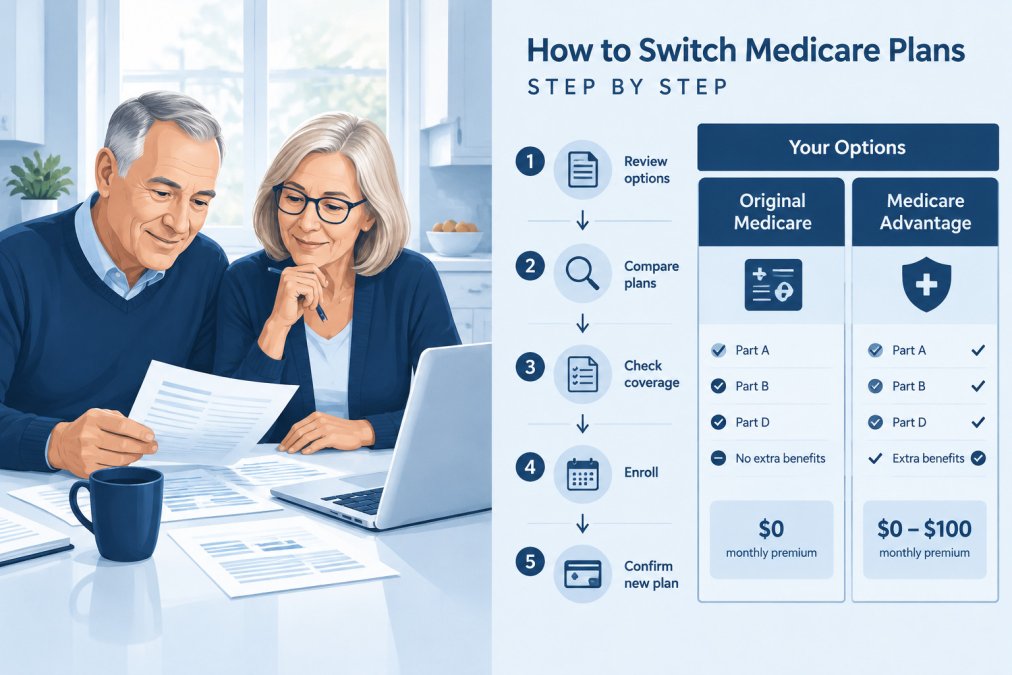
Verifying Provider Network Continuity Before You Switch
Provider network continuity is one of the most overlooked parts of switching. Before you enroll, search the plan's provider directory for each doctor, specialist and hospital you rely on. Call the doctor's office directly to confirm they accept the plan, since directories can be out of date.
If a key provider is missing, you have three choices: keep your current plan, find a different doctor in the new network, or ask whether the plan makes exceptions. Making this check before enrollment is far easier than discovering the gap after your effective date.
Special Considerations: Chronic Conditions, Special Needs Plans and Geographic Moves
If you manage a chronic condition such as diabetes, heart disease or kidney disease, look for a Chronic Condition Special Needs Plan (C-SNP). These plans are designed for people with specific conditions and may include care coordination and specialist access tailored to those needs. Eligibility is set by condition and by plan, so check the requirements carefully.
Geographic moves also affect your coverage. Most Medicare Advantage plans serve a defined service area, so if you move out of it, you may need to change plans. Check whether your plan covers your new address before a move, and confirm your options during the relevant enrollment period.
Booking Your Free Plan Comparison With Your Medicare Advantage Guy
Choosing between Original Medicare and Medicare Advantage involves many details, and a single mistake can cost you a doctor or a medication. Our service compares plans from multiple top-rated carriers and keeps the focus on your doctors, prescriptions and budget. The service is offered at no cost and with no obligation.
Michael Wilson, a licensed independent advisor, can review your options with you. Request your free Medicare Advantage quote to start a plan comparison built around your needs. For a deeper look at the enrollment rules first, read Medicare special enrollment periods explained, or compare the trade-offs in Medicare Supplement vs. Medicare Advantage: which is better?.
Frequently Asked Questions
What is the downside of having Medicare Advantage?
Medicare Advantage plans often use provider networks, so out-of-network care may cost more or go uncovered. Plan rules on referrals and pharmacies vary. Before enrolling, check that your doctors and preferred hospitals are in the plan's network for the coming year, review the formulary for your prescriptions, and compare the maximum out-of-pocket amount. Medicare.gov's Plan Finder lets you run these checks.
Can I switch back to Original Medicare and cancel Medicare Advantage?
Yes, in most cases. You can often leave a Medicare Advantage plan and return to Original Medicare during the Medicare Advantage Open Enrollment Period. Confirm the current dates on Medicare.gov. Enrolling in a Medicare Advantage plan may affect any Medigap policy you had, so confirm with your insurer how re-enrolling in Medigap would work. Confirm the exact rules and dates with Medicare.gov or 1-800-MEDICARE before making a change.
Can I switch to Medicare Advantage at any time?
Not always. The Annual Enrollment Period each fall and early winter is the main window for switching. The Medicare Advantage Open Enrollment Period lets people already in a Medicare Advantage plan change plans. Confirm current dates on Medicare.gov. Special Enrollment Periods can apply in certain situations; check Medicare.gov for your options. Eligibility depends on your situation, so check Medicare.gov for your options.
What should I compare before switching Medicare plans?
Compare total yearly costs, not just the monthly premium. Look at deductibles, copayments and coinsurance, the plan's maximum out-of-pocket amount, and drug costs for your specific prescriptions. Confirm your doctors, specialists and preferred hospitals are in network, and check whether the plan requires referrals. Also review dental, vision and hearing benefits, and any fitness or telehealth extras you would actually use.